The Death of Technical Execuses

We’re watching the complete collapse of the old excuses that used to stop people from launching products online. For years people would say things like, “I’m not a designer,” or “I don’t know copywriting,” or “I can’t code,” or “I don’t know how to build a sales page.” Those excuses are disappearing in real time.
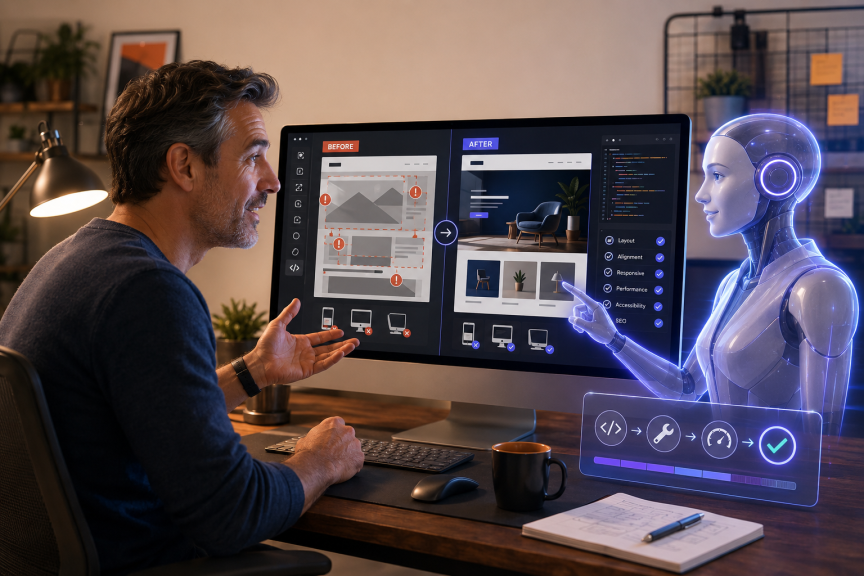
What’s replacing them is a workflow where a single person can sit down with an idea, explain it in plain English to an AI system, and walk away with a fully functioning landing page, complete with copy, design, layout, graphics, pricing sections, feature blocks, charts, FAQs, and even conversion-focused improvements. That’s not theory anymore. That’s the reality.
The interesting part is that despite all the new tools, all the AI systems, all the automation, and all the hype surrounding technology, the fundamentals of marketing really haven’t changed at all. Marketing is still marketing.
Human psychology still matters.
The reason people buy still hasn’t changed. We’re simply using better and faster tools to execute ideas. What AI is really doing is removing the need for saying we can’t do something.
Most people don’t fail because they lack ideas. They fail because they get stuck between the idea and the execution. They get
trapped in the middle. They overthink. They wait. They try to perfect things before they launch. AI is now eliminating many of those delays.
One of the biggest roadblocks for most marketers has always been the sales letter or landing page. You create a product. You come up with an offer. Maybe you even build the software or create the training. Then comes the hard part: putting together a page that actually sells it.
Traditionally that required multiple skills. You needed a copywriter, a designer, maybe a coder, maybe a WordPress developer, and usually a lot of patience. Today, AI can handle the majority of that process almost instantly.
Instead of saying, “Write me a sales letter,” a much smarter approach is to ask AI to create a landing page. That subtle shift changes the output dramatically. A sales letter prompt often produces long-form copy that lacks visual structure.
A landing page prompt encourages AI to think visually. It starts building sections, layouts, graphics, calls to action, comparison charts, feature grids, and interactive elements. Suddenly the AI isn’t just writing. It’s designing. That distinction matters because modern conversions depend heavily on presentation and user experience.
What’s remarkable is how little information AI actually needs to get started. You can give it a product name and a one-sentence explanation, and it will begin constructing a complete marketing experience around it.
AI tools like Claude, ChatGPT, Google AI Studio, Lovable, and others are now capable of generating full HTML landing pages with styling, graphics, interaction, and conversion-focused structure in a matter of minutes.
The speed is honestly shocking when you step back and think about it. We’re talking about building four completely different website concepts simultaneously from almost no input at all.
Of course, not every design is perfect. Some layouts will feel wrong. Some fonts won’t match the tone you want. Some sections may look visually unbalanced, but that’s where the real power of AI starts to appear.
The process is conversational. You don’t need technical knowledge to improve the page. You simply tell the AI what you don’t like. Change the theme. Adjust the colors. Use a lighter design. Replace the fonts. Tighten the spacing. Add comparison charts. Create stronger feature blocks.
Make the call-to-action sections more visible. AI responds to direction remarkably well when you treat it like a collaborative designer instead of a vending machine.
One of the most overlooked strategies is using AI against itself. Most people stop once the first draft is finished. That’s a mistake. The real breakthrough happens when you ask AI to critique its own work. You can literally say, “Analyze this page from a design standpoint and tell me how to improve the aesthetics and organization for better conversions.”
Then after it finishes, you ask it to analyze the same page from a copywriting standpoint. Suddenly the AI becomes both the creator and the reviewer. It identifies weak sections, inconsistent branding, ineffective headlines, poor layout balance, weak call-to-actions, and missing trust signals. Then it suggests improvements and often implements them automatically.
Another fascinating aspect of this process is how AI allows marketers to borrow inspiration without manually recreating designs. You can study existing landing pages, identify features you like, take screenshots of layouts or sections, and feed those references directly back into the AI system.
Instead of copying websites, you’re guiding the AI toward specific visual ideas and conversion elements. Maybe you like a comparison chart from one site, a feature block from
another, and a hero section from a third. AI can combine those concepts into something entirely new while keeping the overall design cohesive.
The barrier between idea and implementation has nearly disappeared.
Years ago, launching a professional-looking sales page required significant money or technical skill. Now a single entrepreneur can create enterprise-level marketing assets in an afternoon, and the quality is getting better almost weekly. AI is beginning to understand design psychology, layout balance, hierarchy, typography, user flow, and conversion optimization at a surprisingly advanced level.
Speed and iteration matter more than perfection. You can test ideas rapidly. You can create multiple versions of the same page. You can adjust headlines, layouts, color schemes, offers, and feature sections almost instantly. If something doesn’t work, change it. If a design feels too heavy on one side, rebalance it. If the copy feels weak, have AI strengthen it. If the fonts don’t match the tone, replace them. Every part of the process is flexible.
This changes the economics of online business dramatically. The cost of execution the time required to test an idea have collapsed. The ability to move from concept to launch has accelerated beyond what most marketers realize.
And yet, despite all of that, the people who will win are still the people who understand marketing fundamentals. AI can generate the structure, but it still takes human judgment to understand what customers want, what emotional triggers matter, and what positioning will actually convert.
That’s why this moment is so exciting. We are entering an era where creativity and speed are finally merging. They’ll launch products, test ideas, refine offers, and scale campaigns quicker. Meanwhile, people stuck in the old mindset will continue believing they need months to create what can now be built in a few hours.
The reality is simple. The excuse that “I can’t build a website” is over. The excuse that “I don’t know copywriting” is over. The excuse that “I’m not technical” is over. AI has fundamentally changed what a single person can accomplish online. The only real question left is whether you’re willing to embrace the process and start experimenting with it yourself. You got this!